Northwest yards contain native bedrock, glacially moved stones and imported landscape aggregate. A rock found beside your driveway does not necessarily tell you what lies beneath the property.
- Texture is usually more useful than color alone.
- Photograph a dry surface and a naturally exposed fresh surface.
- A garden-stone trade name may describe size or shape rather than geology.
Describe before naming
Use a hand lens and ruler. Record grain size, visible crystals, holes, bands and rounded or angular edges. Look for a natural broken surface; a weathered skin can conceal the interior. Describe what you see in ordinary terms before reaching for a name.
Think about context. A rounded cobble may have been transported by water or ice. Decorative gravel may have arrived by truck. Basalt, granite and pumice can all occur far from the outcrop that produced them. A geological map helps interpret a location, but it cannot identify every loose stone placed there.
Common starting points
The table offers candidates to compare, not a replacement for mineral examination or laboratory analysis.
| Candidate | Typical clue | What the clue cannot prove |
|---|---|---|
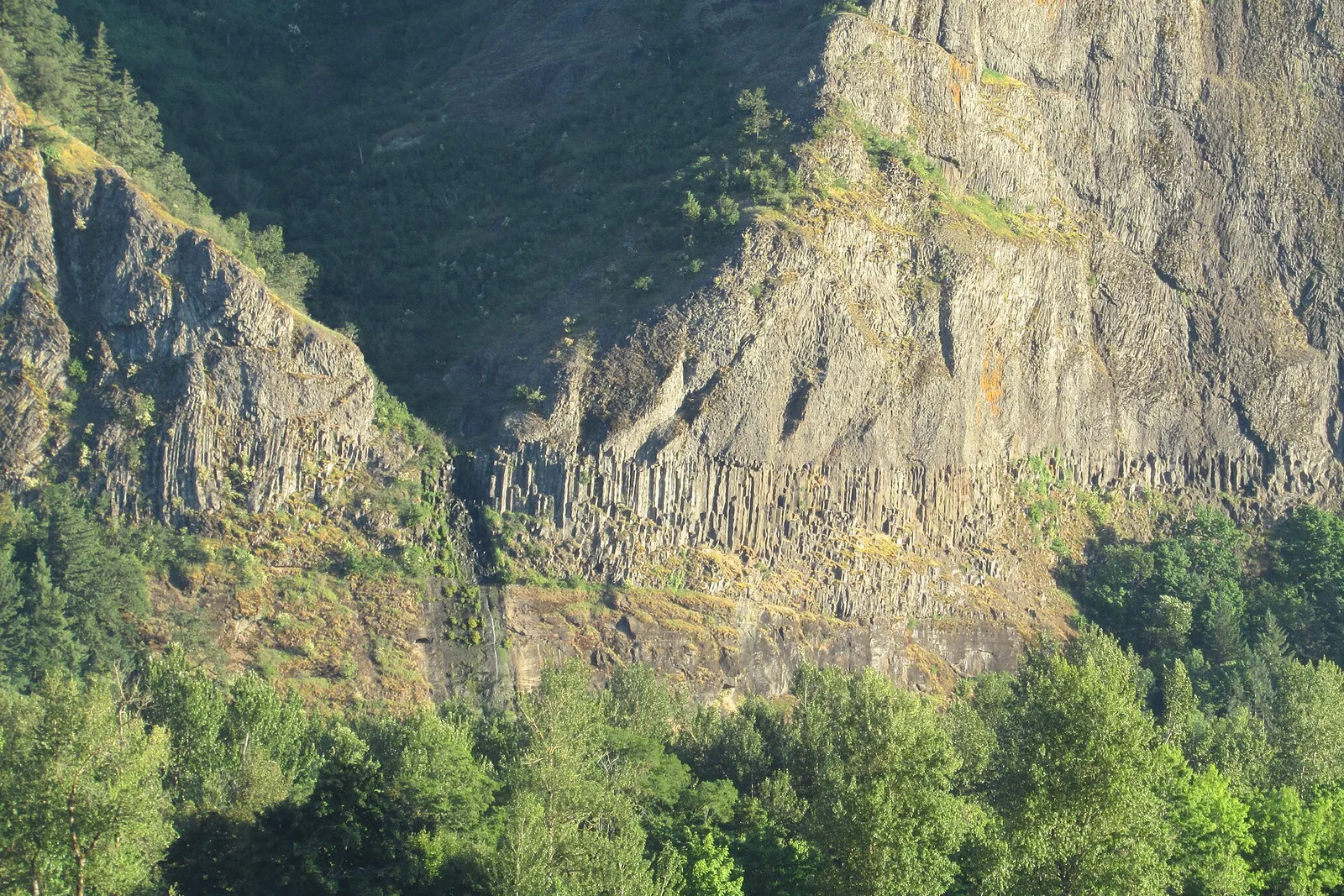
| Basalt | Dark, fine-grained volcanic rock; sometimes contains gas-bubble holes | Dark color alone does not distinguish all volcanic rocks |
| Andesite | Fine-grained volcanic rock, sometimes with larger crystals in a finer matrix | It can overlap basalt in appearance |
| Granite or a related intrusive rock | Clearly visible interlocking mineral grains, often including pale feldspar and glassy quartz | Many speckled rocks are other granitoids or diorite |
| Pumice | Frothy, highly porous volcanic material that feels unusually light | Not every hole-filled rock is pumice |
| Sandstone or other sedimentary rock | Visible sediment grains, layers or cemented fragments | Bands can also occur in metamorphic or volcanic rocks |
Choose stone by the job
For a path, ask the supplier about particle size, angularity, compaction and drainage. For a planting bed, ask where the stone came from and whether fines will wash onto neighboring surfaces. For a retaining structure or drainage installation, the required engineering properties matter more than a guessed rock name.
A bucket of decorative rounded pebbles and a compactable crushed aggregate behave differently underfoot. Keep a sample, supplier description and receipt. This lets you match an addition later without pretending that a photograph can guarantee the same source or grade.
Observe responsibly
Check ownership and the land manager’s current collecting rules before removing any specimen. A public trail, riverbank or roadside is not automatic permission. Leave cultural materials and sensitive sites undisturbed, and do not dig into a slope, roadcut or drainage facility for a sample.
For an uncertain stone, take scaled photographs and your observation notes to a geological survey resource, museum or knowledgeable local geology group. Leave potential structural, contamination or slope-stability questions to an appropriate professional; appearance alone cannot settle them.
Questions that come up
Does river rock mean a particular rock species?
No. It commonly describes water-rounded landscape stone, which can contain several rock types.
Can I identify basalt from a black color?
Only tentatively. Texture, minerals and geological context matter, and some specimens require expert examination.
Sources & further reading
Independent guidance, with regional extension and primary references. The linked product label and local conditions take priority over a generic schedule.
- A set of Washington rocks and minerals for schoolsWashington Division of Mines and Geology
- A guide for the preliminary evaluation of rock for road surfacing: rock classificationWashington Department of Natural Resources
- The rock cycle and rock typesU.S. Geological Survey
- Rockhounding: check land ownership and collecting rulesWashington Department of Natural Resources